The Responsibility of Experience
Written By Mark Janicello
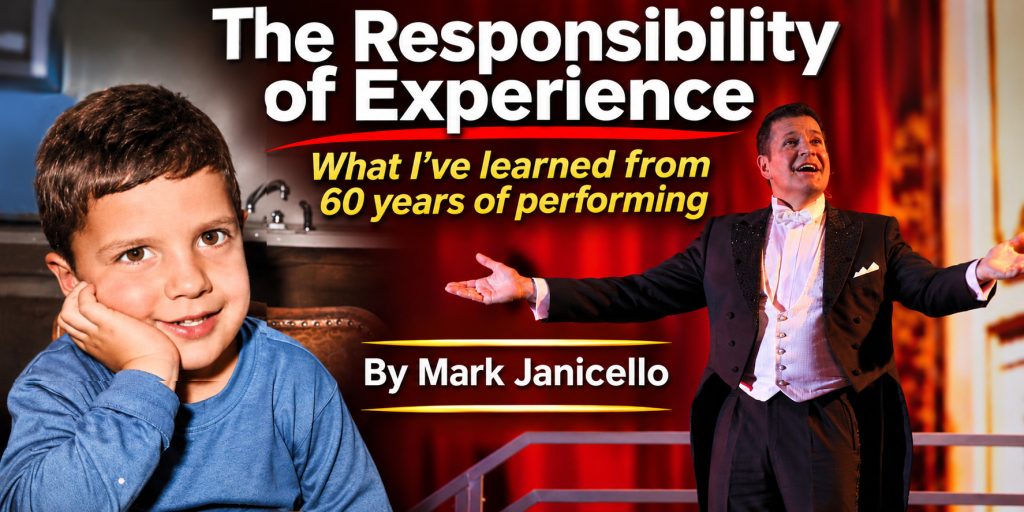
When I was a very small boy, I was watching television one evening, when I saw Michael Jackson and his brothers performing as The Jackson Five. I sat spellbound in front of the TV. There was a little boy, just a bit older than I was, singing and dancing. He wasn’t only good, he was amazing. He had the voice of an angel and sang with so much passion, emotion and for lack of a better word “soul.” I ran and got my Mom and made her watch the TV with me. After the song finished, I said to my parents,”That’s what I’m going to do when I grow up, sing just like that boy.”
Shortly thereafter, I announced to my Mom that I wanted to sing in Grandpa’s church. My Grandfather was a pastor. My mother was a pianist, gospel singer and composed original gospel songs, so there was music in my family. After I expressed my wish to sing, my mother asked “By yourself?” to which I replied, “Yes, like the boy on TV.” We rehearsed a little bit at home, and finally a week or two later, I stood near the organ on the pulpit of my Grandfather’s church, prepared for my very first public performance. My mother was playing the organ for me, and I planned on singing a gospel song called “I Asked The Lord.”
My mother played the introduction, and when it was my turn to sing, NOTHING came out of my mouth but a little dry squeak. Being the precocious child that I was, I said “Wait a minute. Mama, I messed up. Can I do it again?” The audience, of course, loved that, and upon my second attempt, I actually sang the song perfectly, to my, and the audience’s great surprise. That moment of picking myself up after a public humiliation and then succeeding was the moment I knew that I would spend the rest of my life as a performer. I was 4 years old.
60 years, 53 countries, and thousands of performances later, I’m still sat it. I still love music, singing and performing as much as I did six decades ago.
When I step onto a stage, I become the least important person in the room. I am there to serve. It’s my job to serve my audience—whether a live audience in a theatre, or a listener at home, my goal is to use whatever talent I have, on any given day to serve the lyrics, melodies and the emotional life of the songs that I perform.
Unlike spoken words, music speaks directly to the human soul. It bypasses rational thought and connects immediately with the emotions of the listener. Music has given me the extraordinary privilege of performing for audiences in more than fifty countries and sharing unforgettable moments with people from every corner of the world.
Whether performing on record, aboard a luxury cruise ship, in some of the world’s most celebrated theatres, at an international festival, or in an intimate private concert, my goals are always the same – to encourage people to forget their everyday worries, to allow themselves to dream again, and to create an experience they will remember long after the final applause.
After 60 years of performing there are a few maxims that I hold as true:
• Every performance is different because every audience is different.
• Your voice changes every single day.
• Your voice is a reflection of your physical state, as well as the condition of your soul and your emotional life on any given day. All of the above will colour your voice and interpretation.
• Perfection is both immeasurable, unattainable and nothing to strive for. On any given day, your responsibility is to do the very best you can with the voice you have that day.
Over the years, I had been asked and was happy to help a few professional singers who were having vocal difficulties. I worked with them to find the problem areas and re-find their confidence as singers again. However, I’ve never had the thought to be a vocal coach or a teacher until relatively recently.
About a year ago, a dear friend asked me if I would teach him some singing technique. He was neither a professional musician, nor did he aspire to a professional career. He simply loved music and wanted to sing for himself and for his partner. He wanted to expand his range a bit and learn better breathing technique. That was his stated goal.
We began working together, and while my friend was not interested in a singing career, I taught him the exact same way, using the exact same techniques that I use in my own singing. I taught my friend the way I would teach any young professional.
Studying singing is more than training your voice. Like every other art form, singing is a study of yourself. One trains not only the muscles of the throat and the breathing mechanism, but rather one trains the mind, and the powers of concentration. Because singing is such an intimate and personal experience, once also deals with the mental and emotional blocks that keep a singer from being fully present, or being able to express themselves freely.
After just a few weeks, my friend’s voice changed dramatically. His tendency to “apologize” for his presence, his voice, and his mistakes slowly disappeared, and a confident man began to express himself through music. Every week, we made progress. Sometimes more, sometimes less, but he kept moving forward, and kept coming back to learn more. Every time my friend showed improvement, I was thrilled for him, as if I was happy for improving my own singing. His progress became my own.
Honestly, I was surprised at how satisfying teaching my friend was for me, so much so, that I opened my own vocal studio so I could teach one day a week. I’m now at the stage of my life and career and have assembled so much knowledge and real-world performing experience that I feel a genuine responsibility to impart this hard-earned practical knowledge and vocal technique to the next generation of performers. To that end, I’ve
codified my own singing technique, which I gleaned from my various A-list teachers into a practical, step-by-step course of study called Vocal Science. It’s a curriculum to help you achieve and maintain your voice, and to help you learn to sing in just about any situation and vocal condition.
Singing uses your body as its instrument. Nevertheless, there are no replacement parts. Unlike a pianist who can buy a new Steinway, or a guitarist who can simply swap out a broken string, a singer is entirely dependent on the physical, mental, and emotional vessel they wake up with every morning.
In today’s entertainment landscape—where instant gratification, auto-tune, and overnight viral fame are often prized above genuine craft—the fundamentals of healthy, sustainable singing are frequently overlooked. Young artists are pushed to deliver vocal gymnastics before they have even learned how to properly support a single sustained note. They are taught to chase internet validation and viewership clicks rather than truth of a song or a lyric, and to mimic algorithmic trends rather than discover their own authentic voice, sound and expression.
That is precisely why those of us who have been fortunate enough to build a life in the arts carry an obligation. Experience isn’t a trophy to be placed on a shelf and admired; it is a torch meant to be passed on. Having weathered the highs and lows of six decades on international stages—from opera houses to cruise ships, from rock musicals to intimate cabarets—I know first-hand what it takes to train, protect and maintain an instrument so that it doesn’t just survive a single performance, or a difficult tour, but thrives and grows over a lifetime.
Whether I am working with a seasoned West End professional or an enthusiastic beginner who simply wants to sing with more freedom in their living room, my philosophy remains unchanged. Technique is not meant to put a singer in a box; it is meant to set them free. When you master the mechanics of breath, resonance, and vocal placement, you stop worrying about how you sound, and you finally earn the freedom to focus on what you are saying.
At the end of the day, an audience doesn’t buy a ticket to hear a display of technical perfection. They come to feel something. They come to be moved, to be transported, and to recognize a piece of their own humanity in the music. That’s what singing does better than any other art form.
My journey began as a four-year-old boy on a church pulpit, terrified after a dry squeak, who simply asked for a second chance to sing his heart out. Sixty years later, every time I step into my studio to teach, I am helping someone else find the courage to take that very same breath—and let their true voice be heard.